Steps for assessing and deciding on grant applications
1. Application vetting
All applications are first reviewed to ensure the required documentation has been provided, as outlined in the relevant program guidelines. Applications cannot proceed to assessment until all required documents are received.
2. Application assessment
Once complete, applications and supporting documentation are assessed against the eligibility and assessment criteria set out in the program guidelines.
3. Recommended outcome
The RAA assessor prepares a written recommendation to the program manager (the decision maker). This recommendation explains how the application does or does not meet the eligibility and assessment criteria set out in the program guidelines. The decision maker then considers the recommendation before approving the application or commencing the preliminary decision process.
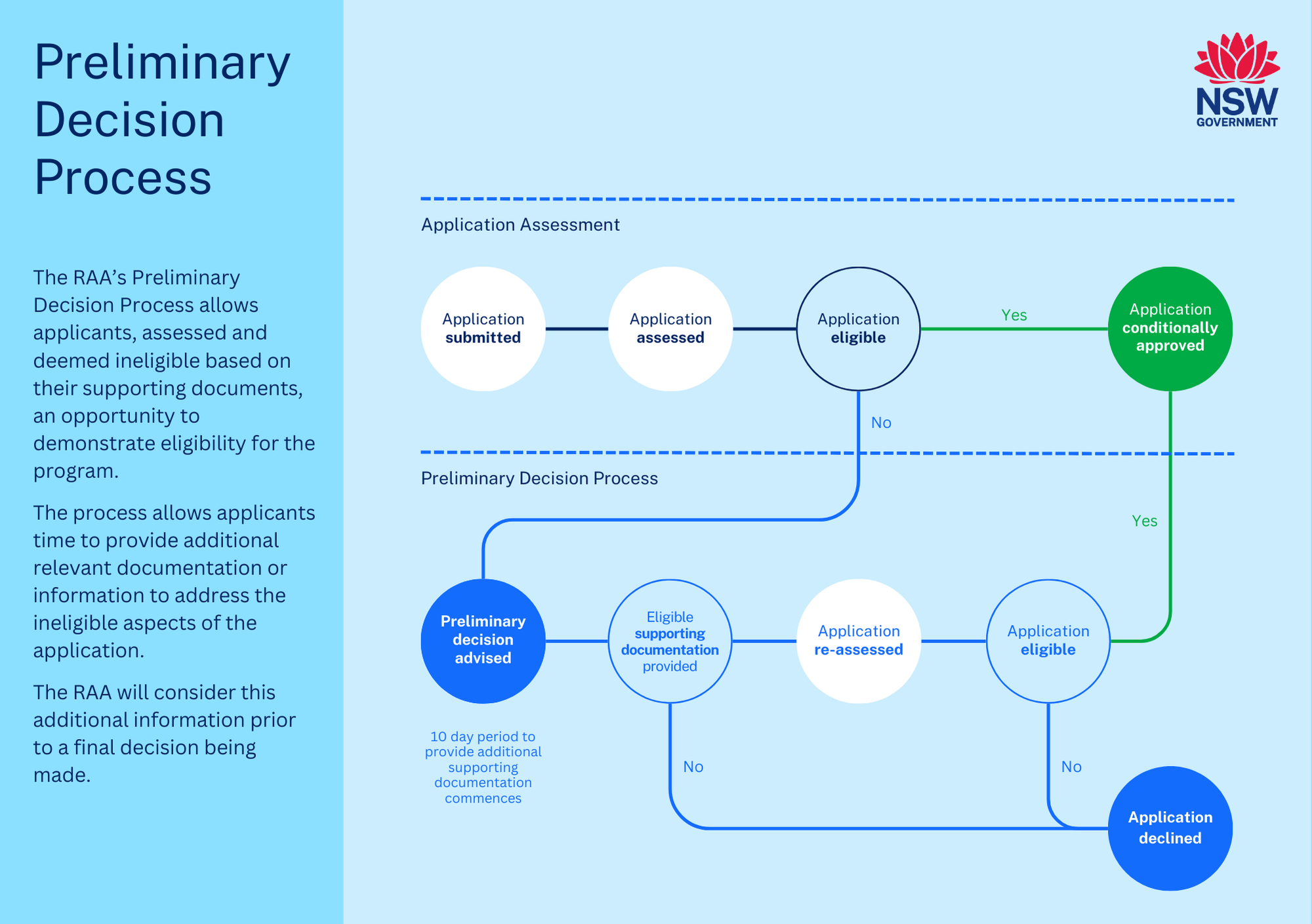
4. Preliminary decision
If an application is assessed as ineligible based on the information provided, the applicant is given the opportunity to demonstrate eligibility by submitting additional relevant documentation or information. Applicants are provided 10 business days from the date of the preliminary decision advice to respond.
5. Final decision
The decision maker considers the recommendation of the RAA assessor and, where applicable, information and documentation forthcoming during the preliminary decision process.
6. Decision notification
Applicants are formally advised of the outcome of their application. Where an application is declined, the reason for the decision is explained.
Frequently asked questions
What are the income requirements for grants?
For most RAA grant programs, applicants must earn the majority of their gross income from the primary production enterprise for which they are applying. Some programs, however, only require that applicants meet a minimum primary production income threshold.
To determine whether an applicant meets the criteria, the RAA may review the financial information of the applicant and any individuals connected to, or associated with, the applying entity.
How is income assessed?
The RAA evaluates the gross income from the applying entity, as well as any individuals or entities that are associated with the applying entity. This includes income earned on and off the farm. Sources such as salaries, dividends, rent, and other regular income streams are all taken into account when assessing eligibility.
What is gross income?
Gross income is the total income and revenue from all sources before any taxes or other deductions are taken out.
Taxable income, net profit and gross profit are not relevant to the RAA’s eligibility assessment.
Who needs to provide financial information?
The RAA will ask for financial information for all individuals involved in a company, partnership, estate, or trust, as well as any shareholders, directors and beneficiaries.

What is a related entity?
A related entity refers to any business or entity in which the applying individual or business has an interest or relationship. This includes entities such as sole traders, partnerships, companies, or trusts. As part of the grant eligibility assessment, the RAA will review the financial information of these related entities. Income is apportioned based on the percentage of ownership or interest held.
What is a new entrant and how is this assessed?
Some RAA program guidelines include a provision for new entrants. This refers to businesses that do not yet meet the income eligibility criteria but can demonstrate that, in the ordinary course of business, they will meet it once their enterprise reaches full commercial production. This provision recognises the lead time required for different industries to become commercially viable.
The RAA consults technical specialists within the department to determine realistic timeframes for each industry sector. For most industries, including livestock, cropping and aquaculture, the allowable lead time is up to three years. For industries with longer production cycles, such as horticulture, the guidelines allow for lead times of up to eight years to account for the time needed to achieve a first harvest. Each application is considered on a case-by-case basis.
To qualify as a new entrant, the applicant must be farming for the first time, have incurred genuine set-up expenses, and provide realistic forecasts. These forecasts are assessed against industry benchmarks, including expected yields and timeframes to commercial viability, as advised by departmental experts.
What is a cash flow forecast and when are these considered in assessments?
A cash flow forecast is an estimate of your future income and expenses. It helps you understand whether you will have enough income to cover your costs, reduce the risk of cash shortages, and avoid unnecessary debt. You can prepare a forecast using a cash flow statement template by entering your estimated figures for each future period. Forecasts must be realistic, accurate, and supported by historical performance. For RAA grant assessments, cash flow forecasts are only taken into consideration when the applicant is assessed as a new entrant.
Can historical financial information be taken into account when assessing a grant application?
Yes. If eligibility cannot be demonstrated using financial information from the most recent financial year, the RAA may request financial information from previous financial years. For example, for natural disaster financial assistance, the RAA can assess any financial period within five years of the natural disaster event date. To be eligible, the applicant must be able to meet the criteria in at least one of those years. This approach allows factors such as seasonal conditions, natural disasters, and biosecurity events to be taken into account when assessing an application.
If my application has been assessed, and a ‘preliminary decision’ has been made, what does this mean?
The RAA's Preliminary Decision Process allows applicants, assessed and deemed ineligible based on their supporting documents, an opportunity to demonstrate eligibility for the program by providing additional relevant documentation or information to address the ineligible aspects of their application. The RAA will consider this additional information prior to making a final decision regarding the application.
The steps in the Preliminary Decision Process are outlined below and further information is available on our Decision Process page.